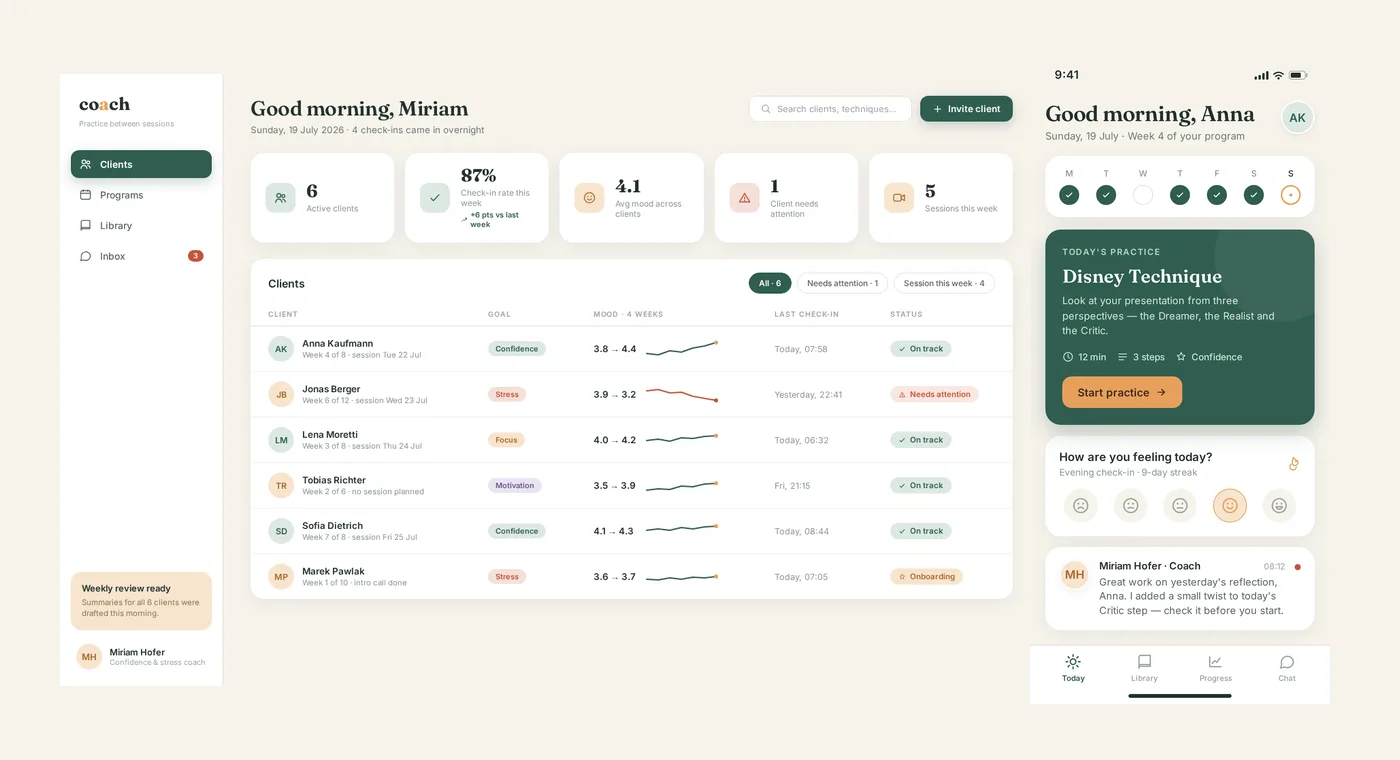
A senior redesign of my own 2021 concept, done AI-first. I reframed a coaching-techniques catalog into a dual-sided practice product: 6 mobile screens for the client's daily loop, 4 web screens for the coach's cockpit, a warm wellness design system built from scratch — and an AI assistant that drafts weekly programs while citing the client's own check-in data, so the coach always decides. Concept work: no live metrics, so the case ends with the target metrics I would instrument first.
Ein Senior-Redesign meines eigenen 2021er-Konzepts, AI-first umgesetzt. Aus einem Technik-Katalog wurde ein zweiseitiges Praxis-Produkt: 6 Mobile-Screens für den täglichen Loop der Klient:innen, 4 Web-Screens für das Coach-Cockpit, ein warmes Wellness-Designsystem von Grund auf — und ein AI-Assistent, der Wochenprogramme entwirft und dabei die Check-in-Daten der Klient:innen zitiert, sodass immer der Coach entscheidet. Konzeptarbeit: keine Live-Metriken — der Case endet mit den Zielmetriken, die ich zuerst instrumentieren würde.
01The product & the reframeDas Produkt & das Reframing
v1 (2021) was a discovery product. A coach published a library of techniques — self-coaching, resource, motivation, attitude work; things like the "Disney technique", "Motivation words" or "Positive attitudes" — and clients browsed them and chatted with the coach, on web and mobile. It solved a real problem: clients finally had access to their coach's methods outside the session.
v1 (2021) war ein Discovery-Produkt. Ein Coach veröffentlichte eine Technik-Bibliothek — Selbstcoaching, Ressourcen-, Motivations- und Einstellungsarbeit; etwa die „Disney-Technik", „Motivationsworte" oder „Positive Einstellungen" — und Klient:innen stöberten darin und chatteten mit dem Coach, auf Web und Mobile. Das löste ein echtes Problem: Klient:innen hatten endlich Zugang zu den Methoden ihres Coaches außerhalb der Session.
But the techniques lived as a static catalog. Reading about the Disney technique is not doing the Disney technique. There was no practice loop, no way to know whether anything happened between sessions — the coach flew blind from one appointment to the next. Five years later I came back to the concept with a sharper question: what is the real job here? The answer reframed the whole product: not "browse techniques" but "practice between sessions".
Aber die Techniken lebten als statischer Katalog. Über die Disney-Technik zu lesen ist nicht dasselbe, wie die Disney-Technik zu machen. Es gab keinen Praxis-Loop, keine Möglichkeit zu wissen, ob zwischen den Sessions überhaupt etwas passierte — der Coach flog blind von Termin zu Termin. Fünf Jahre später bin ich mit einer schärferen Frage zum Konzept zurückgekehrt: Was ist hier der eigentliche Job? Die Antwort hat das ganze Produkt neu gerahmt: nicht „Techniken durchstöbern", sondern „zwischen den Sessions üben".
| v1 · 2021 | Redesign · 2026 | Why | |
|---|---|---|---|
| Core object | Technique page — text to read | Technique player — guided steps + reflection | reading ≠ practicing |
| Client entry point | Library to browse | "Today's practice" — one assigned technique | choice overload kills habits |
| Between sessions | Invisible to the coach | Check-ins, reflections, mood trend the coach can see | coaching continuity is the value |
| Coach's tool | Content publishing | Program builder + client dashboard | from librarian to practitioner |
| AI | None | Assistant with visible reasoning — coach decides | draft, don't replace |
What survived from v1 — and what was deliberately kept outWas aus v1 überlebt hat — und was bewusst draußen blieb
Survived: the technique library itself (it is good content architecture — four families: self-coaching, resource, motivation, attitude), the coach–client chat, and the dual-platform split: clients live on mobile, coaches work on web. Kept out: a public marketplace of coaches, video calls, and any "AI coach" mode. The product's premise is that the human coaching relationship already exists — the software serves it, it does not compete with it.
Überlebt: die Technik-Bibliothek selbst (gute Content-Architektur — vier Familien: Selbstcoaching, Ressource, Motivation, Einstellung), der Coach-Klient:innen-Chat und die Plattform-Aufteilung: Klient:innen leben auf Mobile, Coaches arbeiten im Web. Bewusst draußen: ein öffentlicher Coach-Marktplatz, Videocalls und jeder „AI-Coach"-Modus. Die Prämisse des Produkts: Die menschliche Coaching-Beziehung existiert bereits — die Software dient ihr, sie konkurriert nicht mit ihr.
02Who it serves — two jobs, one loopFür wen es ist — zwei Jobs, ein Loop
The redesign hangs on two jobs that feed each other. The client's practice produces the data; the data makes the coach's next program better; the better program makes practice stick. Every screen serves one side of this loop.
Das Redesign hängt an zwei Jobs, die einander speisen. Die Praxis der Klient:innen erzeugt die Daten; die Daten machen das nächste Programm des Coaches besser; das bessere Programm lässt die Praxis haften. Jeder Screen dient einer Seite dieses Loops.
03Design system — warm, premium, calmDesignsystem — warm, premium, ruhig
Coaching software should not feel like a CRM, and a wellness app for adults should not feel like a toy. The system is deliberately distinct from my other products: a cream paper base, deep sage as the color of practice and coach presence, apricot for action and energy — and one terracotta reserved exclusively for "this client needs attention". Fraunces, a display serif, carries the warmth; Inter does the work.
Coaching-Software sollte sich nicht wie ein CRM anfühlen — und eine Wellness-App für Erwachsene nicht wie ein Spielzeug. Das System ist bewusst anders als meine anderen Produkte: Creme als Papier-Basis, tiefes Salbeigrün als Farbe von Praxis und Coach-Präsenz, Apricot für Aktion und Energie — und ein Terrakotta ausschließlich für „diese:r Klient:in braucht Aufmerksamkeit". Fraunces, eine Display-Serif, trägt die Wärme; Inter macht die Arbeit.
Semantic roles, not decoration: sage = practice & coach presence, apricot = action & energy, danger appears only on attention flags — so when the coach sees terracotta, it always means the same thing.Semantische Rollen statt Dekoration: Salbei = Praxis & Coach-Präsenz, Apricot = Aktion & Energie, Danger erscheint nur auf Aufmerksamkeits-Flags — wenn der Coach Terrakotta sieht, bedeutet es immer dasselbe.
Type, radius, icons — the rest of the systemTypo, Radius, Icons — der Rest des Systems
| Token group | Decision | Why |
|---|---|---|
| Type | Fraunces (display serif) for headings & numbers · Inter for UI | warmth without losing legibility in dense coach views |
| Radius | 20px cards — one generous radius everywhere | soft, premium, instantly recognizable against my other systems |
| Icons | Custom stroke SVG set — no emoji anywhere | emoji read as casual; a paid coaching product must read as considered |
| Surfaces | Soft tints (sage soft / apricot soft) instead of borders for grouping | calm hierarchy; borders reserved for interactive elements |
| Density | Client app: one primary action per screen · coach web: data-dense but tinted, never gridlocked | same tokens, two rhythms — one product |
04Client app — the practice loopClient-App — der Praxis-Loop
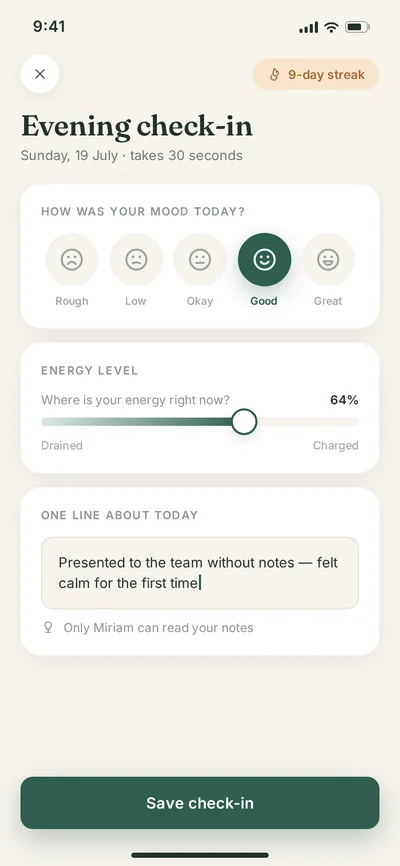
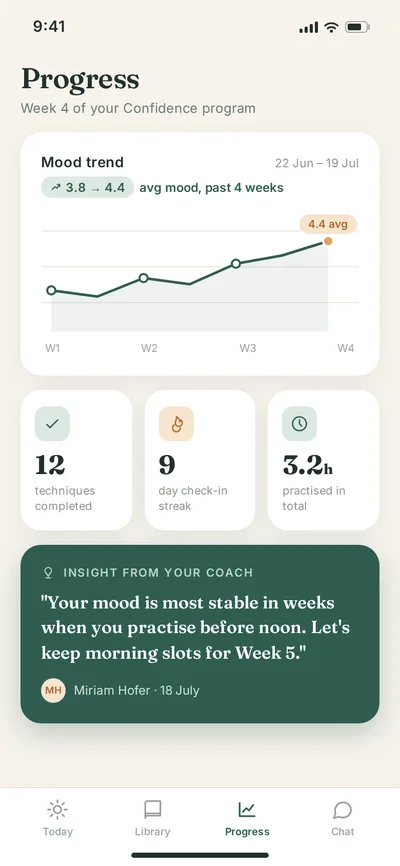
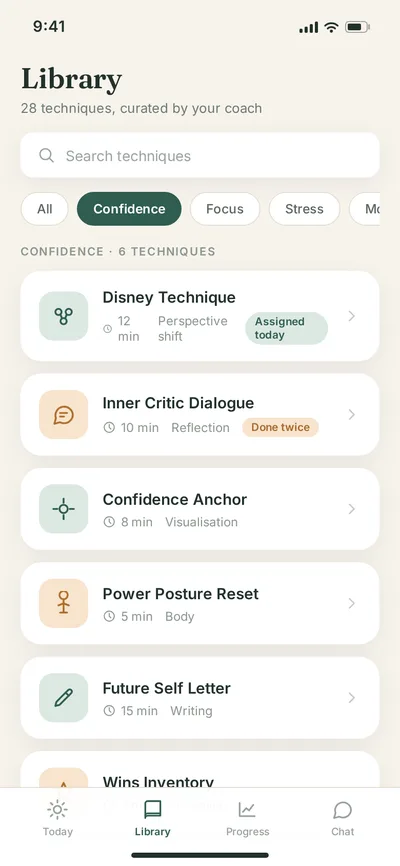
The client's home screen answers one question: what is my practice today? The assigned technique sits on top; a mood & energy check-in with a streak keeps the daily touchpoint light; progress shows a 4-week mood trend rather than raw logs; the library — the heart of v1 — is still there, now filtered by goals: Confidence, Focus, Stress, Motivation. And chat carries technique cards, so "try this one" is a tap, not a description.
Der Home-Screen beantwortet eine Frage: Was ist heute meine Praxis? Die zugewiesene Technik steht oben; ein Stimmungs- & Energie-Check-in mit Streak hält den täglichen Kontakt leicht; der Fortschritt zeigt einen 4-Wochen-Stimmungstrend statt roher Logs; die Bibliothek — das Herz von v1 — ist noch da, jetzt gefiltert nach Zielen: Selbstvertrauen, Fokus, Stress, Motivation. Und der Chat trägt Technik-Karten — „probier mal diese" ist ein Tap, keine Beschreibung.
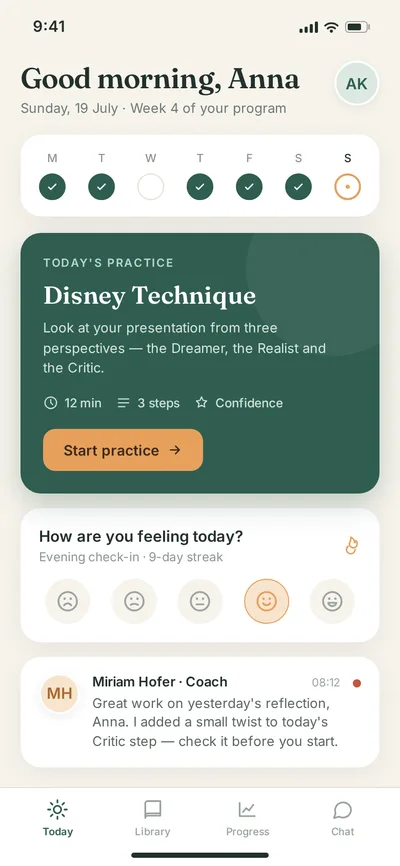
Chat with the coach — where the two sides meetChat mit dem Coach — wo sich beide Seiten treffen
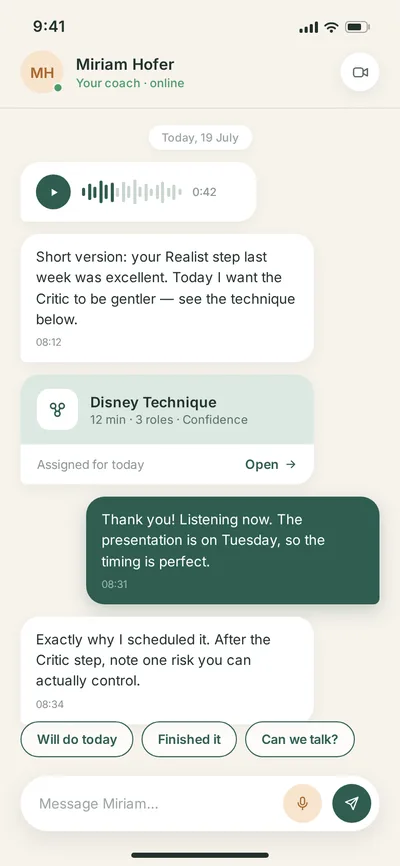
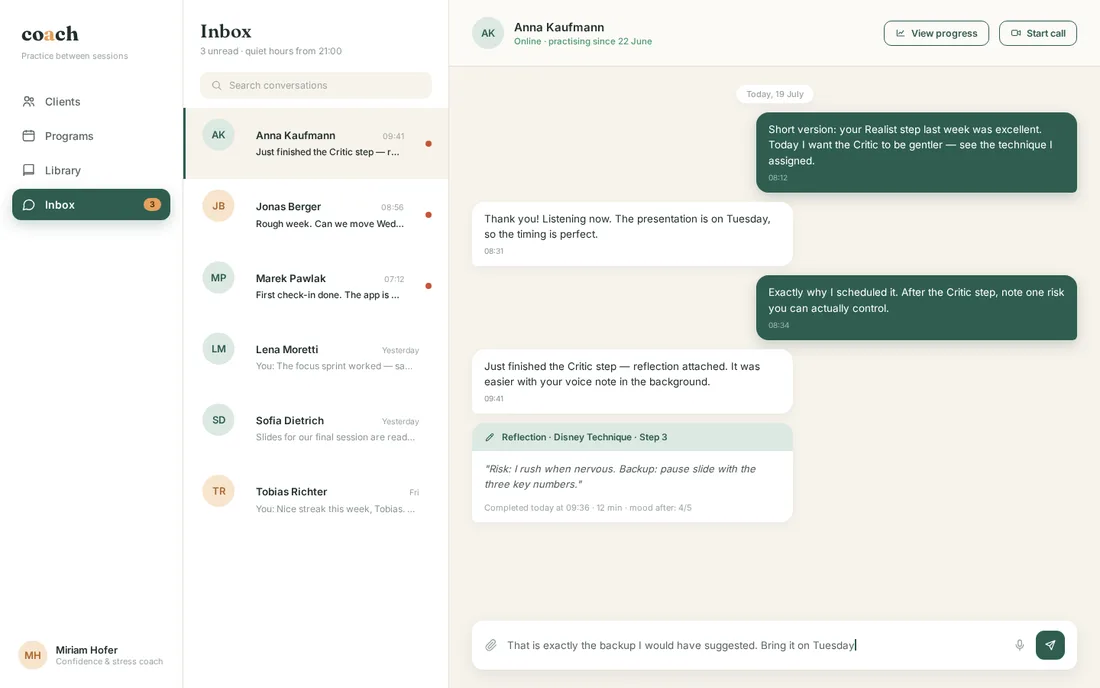
The chat is deliberately not a messenger clone: technique cards are first-class objects. When a coach shares one mid-conversation, it becomes actionable — the client can start the player from the bubble, and it appears in their plan.
Der Chat ist bewusst kein Messenger-Klon: Technik-Karten sind vollwertige Objekte. Teilt der Coach eine im Gespräch, wird sie handelbar — der Player startet direkt aus der Bubble, und die Technik erscheint im Plan.
05The technique player — reading became doingDer Technik-Player — aus Lesen wurde Tun
This is the screen that carries the whole reframe. In v1, the Disney technique was an article. In 2026 it is a guided, step-by-step player: the client moves through the Dreamer, Realist and Critic perspectives one at a time, writes into each, and closes with a reflection — which they can keep private or share with their coach. One step on screen at a time: no wall of instructions, no skipping ahead, a clear sense of progress.
Dieser Screen trägt das ganze Reframing. In v1 war die Disney-Technik ein Artikel. 2026 ist sie ein geführter Schritt-für-Schritt-Player: Klient:innen durchlaufen nacheinander die Perspektiven Träumer, Realist und Kritiker, schreiben in jede hinein und schließen mit einer Reflexion — privat oder mit dem Coach geteilt. Ein Schritt pro Screen: keine Anleitung als Textwand, kein Vorspringen, ein klares Gefühl von Fortschritt.
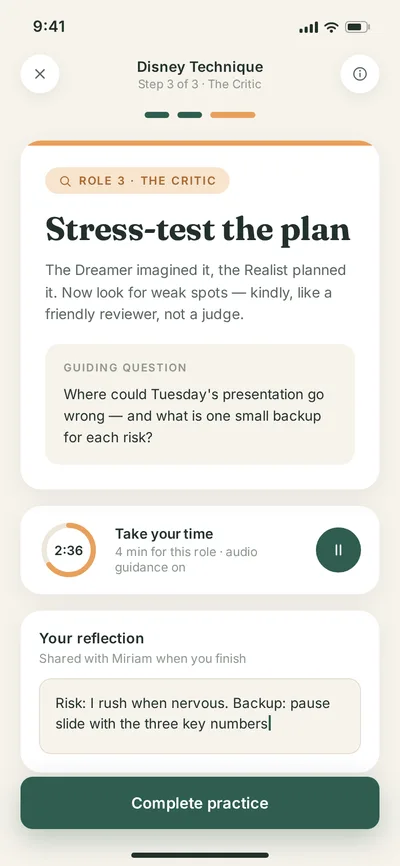
Why steps and a reflection — three design argumentsWarum Schritte und eine Reflexion — drei Design-Argumente
1 · Steps create completion. A technique with a visible step count can be finished — and finishing is what feeds the streak, the progress trend and the coach's view. An article can only be closed.
1 · Schritte erzeugen Abschluss. Eine Technik mit sichtbarer Schrittzahl kann man beenden — und Beenden speist Streak, Fortschrittstrend und die Sicht des Coaches. Einen Artikel kann man nur schließen.
2 · One perspective at a time is the method itself. The Disney technique works precisely because the Dreamer never argues with the Critic. The UI enforces what the methodology asks for — the interface is the facilitation.
2 · Eine Perspektive nach der anderen ist die Methode selbst. Die Disney-Technik funktioniert genau deshalb, weil der Träumer nie mit dem Kritiker streitet. Die UI erzwingt, was die Methodik verlangt — das Interface ist die Moderation.
3 · The reflection is the bridge. A shared reflection is the single artifact that travels from client practice into the coach's inbox — it turns "I did the exercise" into material for the next session, on the client's terms.
3 · Die Reflexion ist die Brücke. Eine geteilte Reflexion ist das eine Artefakt, das von der Praxis in die Inbox des Coaches wandert — sie macht aus „ich habe geübt" Material für die nächste Session, zu den Bedingungen der Klient:innen.
06Coach cockpit — see the week, not just the sessionCoach-Cockpit — die Woche sehen, nicht nur die Session
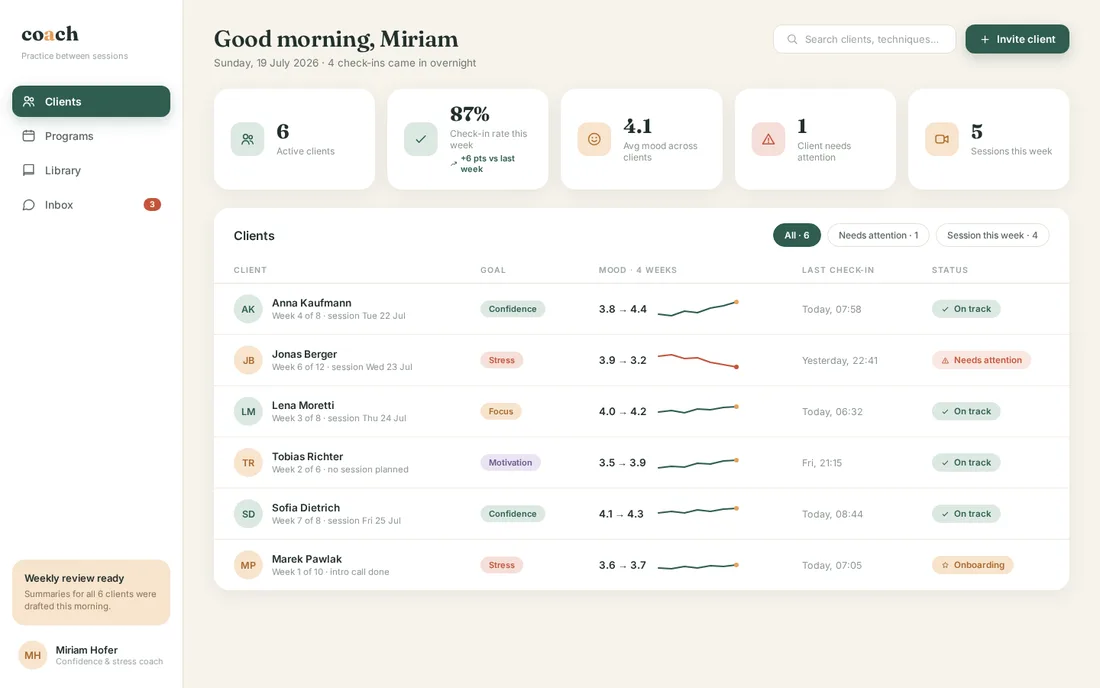
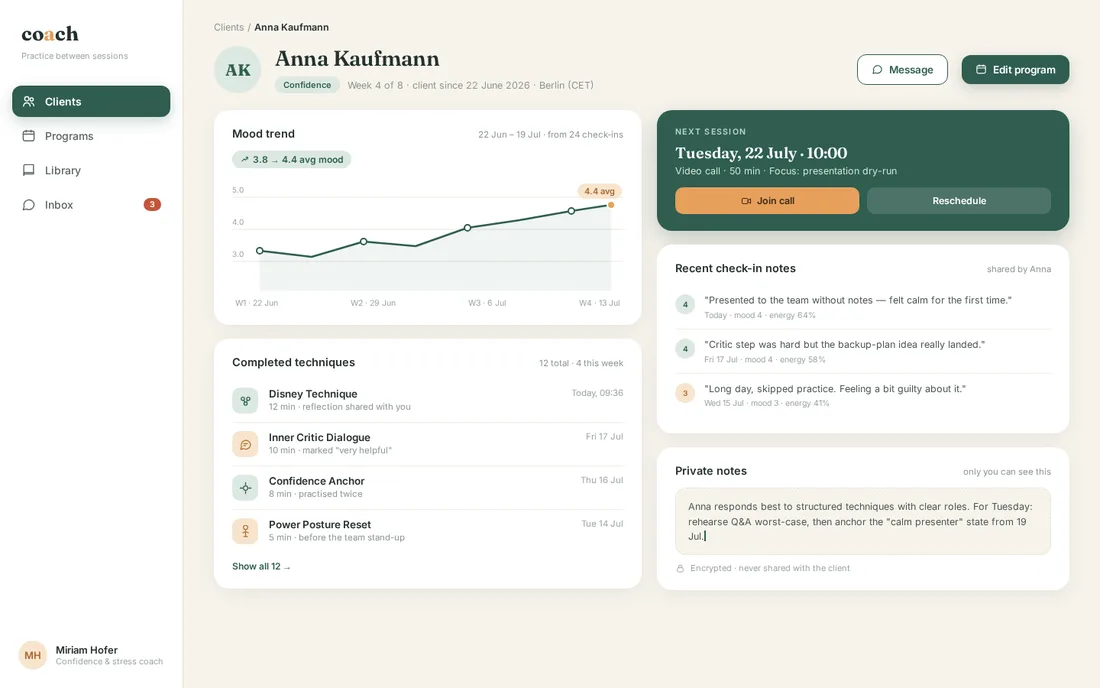
The coach's web app opens on a client dashboard: every client as a card with a mood sparkline and, where needed, a needs-attention flag. One click deep is the client detail — for Anna Kaufmann: mood moving 3.8 → 4.4 over the program, 12 techniques completed, 24 check-ins, the full practice history under the trend. The inbox collects shared reflections, so preparing a session starts from what the client actually wrote — not from memory.
Die Web-App des Coaches öffnet mit einem Klienten-Dashboard: jede:r Klient:in als Karte mit Stimmungs-Sparkline und, wo nötig, einem Aufmerksamkeits-Flag. Einen Klick tiefer liegt das Klienten-Detail — bei Anna Kaufmann: Stimmung von 3,8 → 4,4 über das Programm, 12 abgeschlossene Techniken, 24 Check-ins, die volle Praxis-Historie unter dem Trend. Die Inbox sammelt geteilte Reflexionen — die Session-Vorbereitung beginnt bei dem, was die Klientin wirklich geschrieben hat, nicht bei der Erinnerung.
07Program builder — AI that shows its reasoningProgramm-Builder — AI, die ihre Begründung zeigt
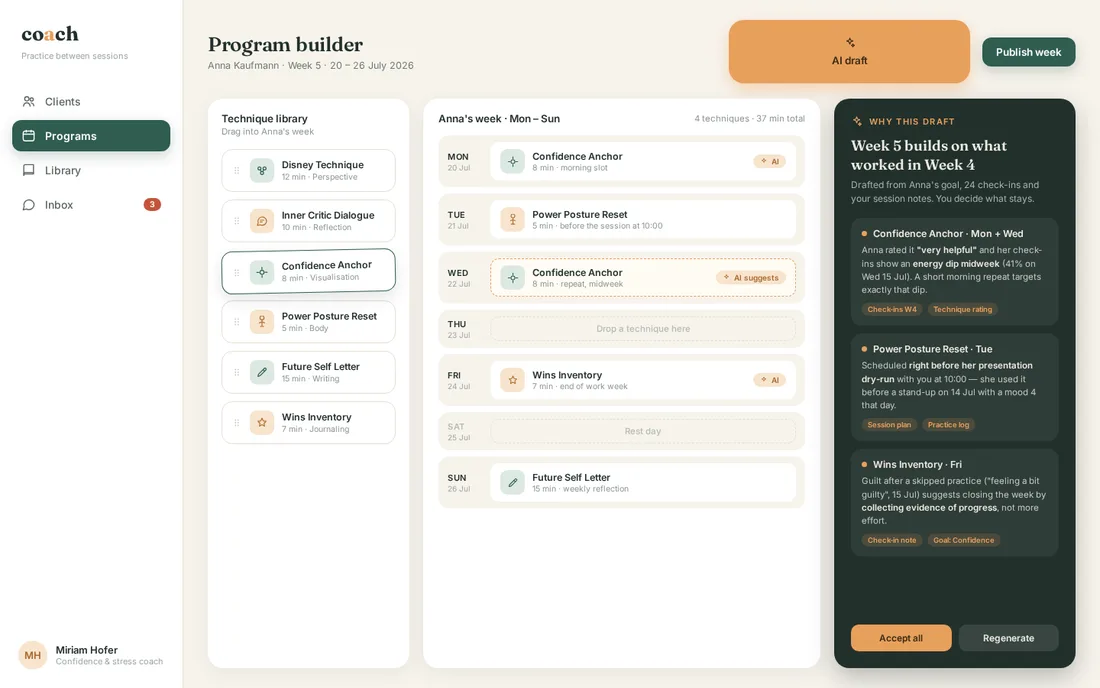
The builder is a weekly plan composed from a technique palette — drag techniques onto days, done. The AI layer drafts that plan first. The design principle, carried over from my other AI products: the assistant must show its reasoning, and the human decides. The AI draft does not say "trust me" — it cites the client's own data: "Wednesday check-ins show a recurring energy dip — I placed a short resource technique there instead of the heavier attitude work." The coach edits, replaces, or discards; nothing reaches the client without the coach.
Der Builder ist ein Wochenplan, komponiert aus einer Technik-Palette — Techniken auf Tage ziehen, fertig. Die AI-Ebene entwirft diesen Plan zuerst. Das Designprinzip, übernommen aus meinen anderen AI-Produkten: Der Assistent muss seine Begründung zeigen, und der Mensch entscheidet. Der AI-Entwurf sagt nicht „vertrau mir" — er zitiert die Daten der Klientin: „Die Mittwochs-Check-ins zeigen ein wiederkehrendes Energietief — dort habe ich eine kurze Ressourcen-Technik platziert statt der schwereren Einstellungsarbeit." Der Coach editiert, ersetzt oder verwirft; nichts erreicht Klient:innen ohne den Coach.
Why visible reasoning is a hard requirement hereWarum sichtbare Begründung hier eine harte Anforderung ist
Coaching is a trust profession. An opaque "AI recommends" would put the coach in an impossible spot: either rubber-stamp what they cannot defend to their client, or ignore the feature entirely. Reasoning tied to check-in data makes the draft checkable — the coach can follow the evidence to the source, agree or overrule, and stay the author of the program. It is the same trust mechanic I designed into my language-learning platform: AI earns trust by showing its work, not by claiming it is right.
Coaching ist ein Vertrauensberuf. Ein intransparentes „AI empfiehlt" brächte den Coach in eine unmögliche Lage: entweder abnicken, was er vor Klient:innen nicht begründen kann, oder das Feature ignorieren. An Check-in-Daten gebundene Begründungen machen den Entwurf prüfbar — der Coach kann dem Beleg zur Quelle folgen, zustimmen oder überstimmen und bleibt Autor des Programms. Dieselbe Vertrauensmechanik wie in meiner Sprachlern-Plattform: AI verdient Vertrauen, indem sie ihre Arbeit zeigt — nicht, indem sie behauptet, recht zu haben.
08Edge & attention states — where danger color earns its keepEdge- & Attention-States — wo die Danger-Farbe sich verdient
A practice product lives or dies on what happens when practice stops. The system's one terracotta is reserved for exactly these moments — and every flag pairs with a designed response, never just an alarm.
Ein Praxis-Produkt lebt oder stirbt mit dem, was passiert, wenn die Praxis stoppt. Das eine Terrakotta des Systems ist genau für diese Momente reserviert — und jedes Flag hat eine gestaltete Antwort, nie nur einen Alarm.
| Signal | Client sees | Coach sees | Principle |
|---|---|---|---|
| Missed check-ins (3+ days) | Gentle re-entry — "pick up where you left off", streak repair, no guilt copy | Needs-attention flag on the dashboard card | shame breaks habits; flags route care |
| Mood trend declining | Nothing automated — no self-diagnosis prompts | Sparkline flagged + suggested check-in message | a human reads the trend, not an algorithm |
| Technique abandoned mid-player | Draft saved; resumes at the same step | Counts as attempted, not failed | partial practice is still practice |
| Empty program week | Library with goal filters as fallback | Builder nudge: "no plan assigned for next week" | the loop must never dead-end |
09Built AI-first — screens designed in codeAI-first gebaut — Screens direkt in Code designt
Same working method as my language-learning platform: the screens were designed directly in code as self-contained HTML — 4 web views and 6 mobile views — then rendered to the images in this case. No static mockup stage: real layout, real type rendering, real states from the first draft, and every design decision reviewable in a browser. I directed structure, system and quality; Claude Code typed the markup.
Dieselbe Arbeitsmethode wie bei meiner Sprachlern-Plattform: Die Screens wurden direkt in Code designt, als eigenständiges HTML — 4 Web-Views und 6 Mobile-Views — und dann zu den Bildern dieses Cases gerendert. Keine statische Mockup-Phase: echtes Layout, echtes Type-Rendering, echte States ab dem ersten Entwurf — und jede Designentscheidung im Browser prüfbar. Ich führte Struktur, System und Qualität; Claude Code tippte das Markup.
Why code instead of clickthroughs: the design system lives as CSS custom properties, so the tokens in section 03 are read from the product, not from a slide — and a stakeholder reviews a product, not a picture of one.Warum Code statt Klick-Dummys: Das Designsystem lebt als CSS-Custom-Properties — die Tokens in Abschnitt 03 sind aus dem Produkt gelesen, nicht von einer Folie. Und Stakeholder reviewen ein Produkt, nicht dessen Abbild.
10Outcome & target metrics — honestly framedErgebnis & Zielmetriken — ehrlich gerahmt
This is a concept redesign: there is no live traffic, so there are no outcome metrics to claim — and I won't invent any. What a senior process does instead is define, before launch, exactly which numbers would prove or kill the reframe. These four would be instrumented first:
Dies ist ein Konzept-Redesign: Es gibt keinen Live-Traffic, also keine Ergebnis-Metriken zu behaupten — und ich erfinde keine. Was ein Senior-Prozess stattdessen tut: vor dem Launch genau definieren, welche Zahlen das Reframing beweisen oder beerdigen würden. Diese vier würde ich zuerst instrumentieren:
| Metric | What it measures | Why it proves the reframe |
|---|---|---|
| Practice completion rate | % of assigned techniques finished in the player per week | the direct test of catalog → practice loop |
| Check-in streak retention | % of clients still checking in weekly at day 30 | is the daily touchpoint light enough to last? |
| Coach weekly active clients | clients per coach with practice activity the coach viewed that week | visibility only matters if coaches use it |
| Time-to-program | minutes from opening the builder to an assigned weekly plan | the AI draft's honest value test vs. building by hand |